Heater Guide · Glow & Gathering
Propane Fire Pits: The Flame That Anchors the Lounge
A propane fire pit table is the fleet's third instrument: 48,000 to 60,000 BTU of open flame at table height, built to hold a circle of guests close for an evening. This guide covers what the burner and tempered glass rocks actually do, how to choose between 48k and 60k, the runtime math on a 20-lb tank, the safety rules Charleston venues enforce, and how pits pair with our mushroom and pyramid heaters. Rentals run the same flat $130 per unit, per event day as every heater in the fleet.
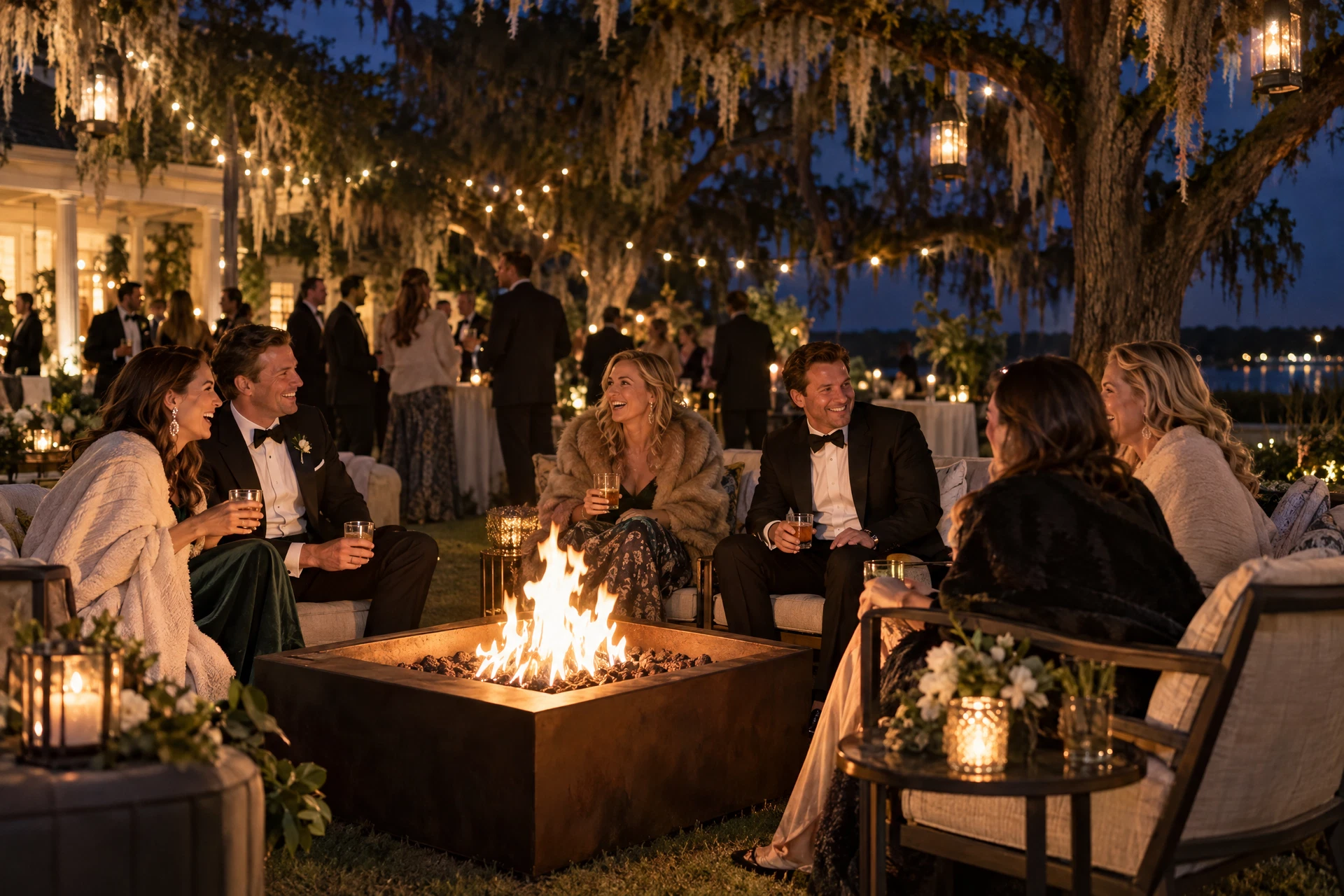
Burner ring vs log set: how the flame is built
Our pits burn propane through a stainless burner ring buried under a bed of tempered glass rocks, not a ceramic log set. The ring spreads gas evenly across a shallow pan, and each rock catches flame along its facets, so the fire reads as a field of glow instead of a fake woodpile. Log sets chase the fireplace look; the burner ring and rock bed are for an even, low, steady flame a guest can sit across without flinching.
The rocks are tempered for a reason: sitting directly above a 48,000 to 60,000 BTU burner, ordinary decorative glass cracks, pops and clouds within a few burns. Tempered glass handles the thermal shock, and a mirrored finish doubles the visible flame by reflecting it back down through the bed — clear reads crisp and modern, mirror reads fuller at the same gas setting. Crews rake and inspect the rock bed between events, because a displaced rock changes how the flame sits.
48,000 or 60,000 BTU, and what wind does to an open flame
Pick the output by the circle, not the crowd size. A 48,000 BTU burner is the right default for a four-to-six chair lounge and most sheltered courtyard events — plenty of glow, gentler on the tank. The 60,000 BTU option earns its gas on larger circles of six to eight, on rooftops where the air moves, and on nights when you want the flame readable from twenty feet away.
An unenclosed flame is the most wind-sensitive fire we place. The mushroom's dome and the pyramid's glass tube both shelter their burners; a pit's flame leans, flattens and loses warmth the moment a steady breeze crosses the table. That is a placement problem, not a hardware failure: set pits behind walls, hedges or furniture blocks, angle seating so the group's backs take the wind, and when the forecast is truly raw let the heaters warm the event while the pit carries the glow.
Table height, seat geometry and the comfort radius
A pit table stands roughly counter height, with the flame a foot or two above the top — deliberately inside the guest's space rather than over it. That geometry changes behavior: chairs circle in close, conversation tightens, and a 36-to-44-inch square does double duty as a table for plates, cocktails and a shared bottle. The comfort radius is eight to ten feet measured outward from the rock bed — a four-to-eight chair circle, not a room.
Sightlines matter at lounge height too. Because the flame sits at eye level for seated guests, it photographs as part of the crowd rather than above it — which is why wedding photographers and send-off lines lean on pits the way they lean on candles. Give the circle room on all sides and keep chair backs out of the thirty-six-inch clearance line.
Tank placement, ventilation and the runtime math
The twenty-pound propane tank lives inside the pit's base on a slide tray, behind ventilated panels that keep any gas from collecting and the regulator cool and readable. Never block those vents with skirts, storage boxes or stacked chair bags — the base is a gas compartment dressed as furniture.
The runtime math is the same arithmetic our heaters run. A full 20-lb tank holds roughly 430,000 BTU. A 60,000 BTU burner on high works through it in just over seven hours; at 48,000 on high the honest number is about nine. Run the pit on medium — which is where Charleston events actually live after the first toast — and one tank covers eight to ten hours, past any dinner service or reception window. Propane is billed per filled tank used, and long festival days get scheduled swaps before the gauge bottoms out.
- 60k burner, high: just over 7 hours per 20-lb tank
- 48k burner, high: roughly 9 hours per tank
- Medium setting: the 8–10 hour window most events run
- Tank rides on a base slide tray; vents stay unblocked
Safety: certifications, clearances and the tent rule
Every pit is CSA/UL listed for outdoor use, with a tip-over shutoff that kills the gas if the table is knocked and a flame-out device that stops flow the moment the burner goes out — the two failures that would otherwise turn an open flame into an open gas line. Both are function-checked on every delivery, alongside the soap-test leak-check on the tank connection, and the shutoff gets demonstrated to your point person before doors.
The clearances are the numbers your insurer will ask for: thirty-six inches from tent fabric, drapery, umbrellas, florals and greenery on every side, on stable level ground. Open-sided tents only — a lit pit never belongs under a fully enclosed tent ceiling, however good the drapery looks. And the honest limitation, said plainly: a fire pit is glow and gathering, not radiant heating. Nobody sits a Charleston December dinner comfortably around a pit alone; that is what the 50,000 BTU mushroom dome is for. The pit holds the lounge; the heaters do the warming.
Finishes: bronze for historic, black for modern, steel for coastal
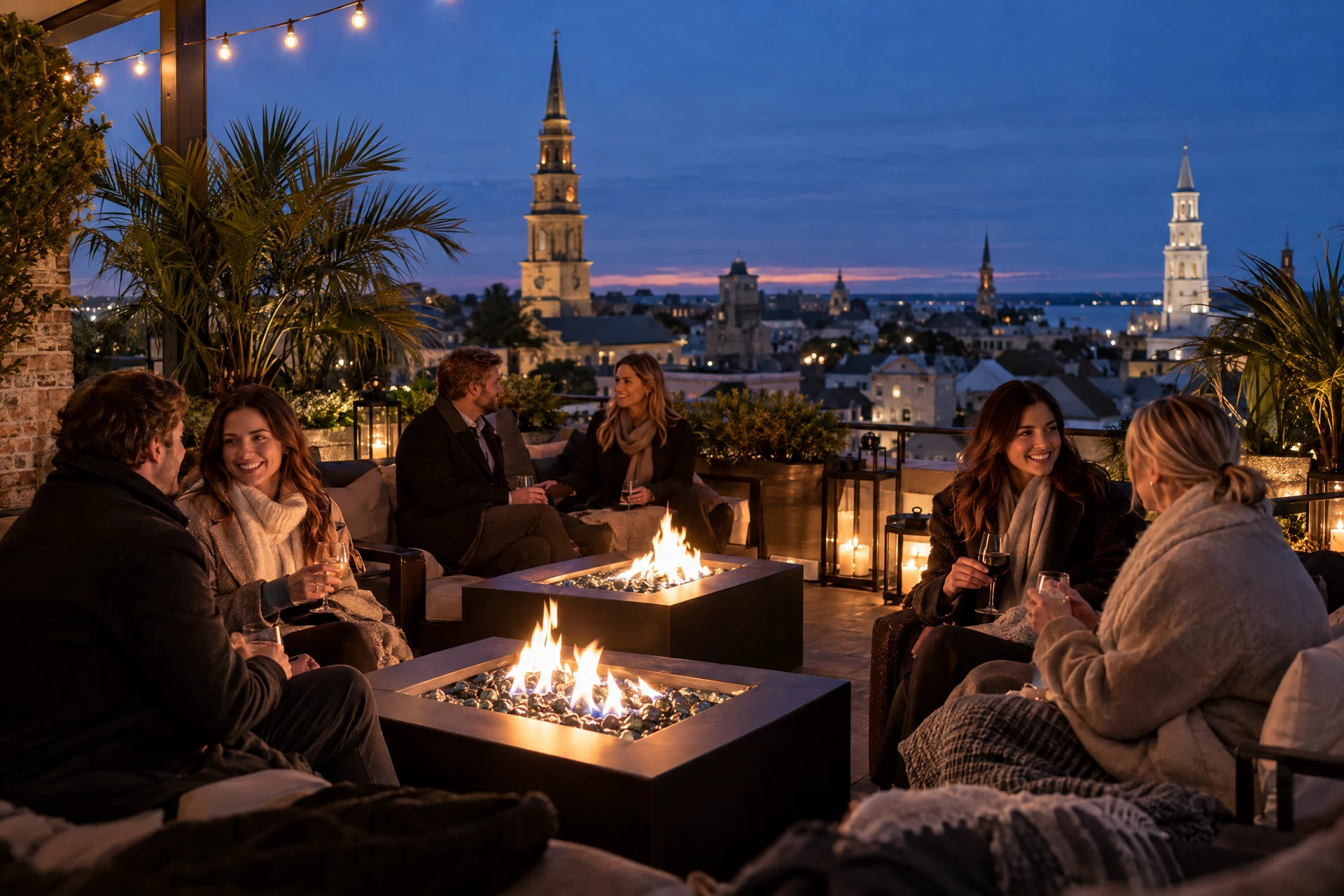
Hammered bronze is the finish historic-house courtyards and garden venues ask for — the textured warm tone reads like period ironwork beside weathered brick and boxwood, and photographs like it has always lived at the venue. Matte black is the rooftop and modern-bar pick: powder-coated, it hides service scuffs and drops out of night frames so the flame carries the picture. Stainless is the salt-air answer for Folly, Isle of Palms and marina-side lawns, and rinses clean after coastal events.
Finishes mix across one event at no price difference, so a common plan runs bronze pits in the garden lounge, black at the rooftop bar and stainless on the marsh-side terrace — paired with matching heater columns so each zone looks intentionally dressed rather than catalog-ordered.
Pairing the fleet: tables, bar, aisles and lounge
The fleet plan fits one sentence: the mushroom heats the tables, the tabletop warms the bar, the pyramid lights the aisle, and the fire pit anchors the lounge. Mushrooms go over dining, where radiant warmth has to reach eight seated guests; pyramids line walks, entrances and reception rows, where the visible flame is doing décor duty; pits hold the circles where guests actually linger — cocktail lounge, farewell line, the rooftop corner with the good view.
Working from a floor plan, we mark all four in one pass: dome dots over tables, a tabletop or two on the bar and card tables, tube dots down the aisle, and one pit at the center of each lounge circle. Same flat $130 per unit, per event day for every rental, propane billed per filled tank used — so the layout decision is about where guests sit, stand and look, never about which unit is cheaper.
Full specification sheet
| Heat output | 48,000–60,000 BTU/hr burner, adjustable |
|---|---|
| Flame media | Tempered clear or mirrored glass rocks |
| Format | Square fire pit table, 36–44 in across |
| Fuel | 20-lb LPG tank on base slide tray, ventilated panels |
| Runtime | ~8–10 hrs medium · ~7 hrs high at 60k per tank |
| Comfort radius | 8–10 ft gathering circle around the table |
| Ignition | Matchless electronic ignition |
| Safety systems | Tip-over shutoff, flame-out device |
| Certification | CSA/UL listed for outdoor use |
| Clearance | 36 in to fabric, greenery and combustibles |
| Tent rule | Open-sided tents only; never under enclosed ceilings |
| Finishes | Hammered bronze, matte black or stainless |
| Rental rate | $130 per pit, per event day |
| Propane | Billed per filled tank used |
Best for
- Wedding cocktail lounges and farewell circles
- Holiday party lounge clusters between heater zones
- Rooftop bars and close-set restaurant tables
- Courtyard corners and aisle ends needing a focal flame
Watch out
- Glow and gathering — not radiant heat for dining rows
- Open-sided tents only, 36 in from all fabric and greenery
- Open flame is the most wind-sensitive fire we place
- Keep base vents clear and lit pits attended when guests are near
See how the pit fits the fleet
Put a flame where the conversation happens
Tell us your date, layout and guest count — the placement plan and quote come back the same business day.
Pits in Charleston settings
Frequently asked questions
Is a fire pit enough to keep guests warm at a winter Charleston event?
Not on its own — and we will never sell it that way. A pit's open flame at table height warms a close circle of faces and wrists across an 8-to-10-foot radius, but it moves with the wind and has no reflector banking heat back into the group. For December dinners, let 50,000 BTU mushrooms warm the tables and let the pit anchor the lounge between them.
How long does one propane tank run a fire pit?
A full 20-lb tank carries roughly 430,000 BTU: about seven hours at the 60,000 BTU high setting, around nine at 48,000 high, and eight to ten hours on the medium setting most events actually run. Propane is billed per filled tank used, and long programs get scheduled swaps so the circle never dims mid-evening.
What safety hardware do the rented pits have?
Every unit is CSA/UL listed with a tip-over shutoff that kills gas if the table is knocked and a flame-out device that stops flow if the burner goes out. Placement holds thirty-six inches from fabric, greenery and umbrellas, the base vents stay unblocked, and our crew leak-checks and demonstrates the shutoff before doors open.
What does a propane fire pit rental cost?
A flat $130 per pit, per event day — the same rate as the mushroom and pyramid heaters — with propane billed per filled tank used. Delivery, placement, leak-check and lighting are quoted per event by distance and site conditions, so the number you approve is the number on the invoice.
Why the lounge fills first
“One pit in the garden lounge became the whole party. The heaters did their job at the tables; the pit did everyone's favorite one.”
“Two matte-black pits on the rooftop all December. Guests circle in and stay two hours longer than they used to.”